
A Kratom Usage Question: How Long After Taking Suboxone Can I Take Kratom?
Moving between modern prescription formulations and traditional botanical products often brings people to a complicated crossroads where cellular science dictates real-world timing. Suboxone and Kratom represent two vastly distinct approaches to human physiology, yet both substances set their sights on similar communication hubs within the nervous system. When someone takes a sublingual strip or tablet of Suboxone, the body enters an extended phase of tight receptor occupancy that fundamentally shifts how any subsequent compound operates. Anyone considering introducing Kratom afterward quickly discovers that timing is not merely a matter of personal preference, but rather a direct consequence of molecular binding strength and metabolic clearance. Unpacking the timeline between these two distinct substances requires looking closely at receptor affinity, product formats, and the biological half-life that governs the entire interaction.
The Pharmacological Architecture of Suboxone
Suboxone is a specialized combination formulation containing buprenorphine and naloxone in a standardized 4:1, developed specifically for sublingual or buccal administration. Buprenorphine is the primary active agent driving the medication's systemic effects, functioning as a high-potency partial agonist at mu-opioid receptors and an antagonist at kappa-opioid receptors. Naloxone is integrated into the formula primarily as a protective deterrent against misuse; when dissolved under the tongue as directed, naloxone exhibits poor oral bioavailability of less than ten percent and produces virtually no systemic receptor activity, while buprenorphine rapidly diffuses across the sublingual mucosa directly into the bloodstream.
What truly sets buprenorphine apart in the field of pharmacology is its exceptionally high binding affinity for mu-opioid receptors, coupled with an unusually slow dissociation rate. In biochemistry, binding affinity measures the physical magnetism and chemical grip with which a ligand attaches to a receptor pocket. Buprenorphine binds to these sites far more tightly than almost any other natural or synthetic substance. Once anchored, it exhibits slow receptor kinetics, remaining locked onto the receptor wall for dozens of hours without breaking down or releasing its hold.
In addition to its tenacious binding strength, buprenorphine features a protracted elimination half-life ranging anywhere from twenty-four to forty-two hours, with its primary active metabolite, norbuprenorphine, lingering even longer during hepatic clearance. Because the molecule occupies receptor pockets so completely and clears so gradually, it creates a persistent biological ceiling. As long as buprenorphine saturates these cellular pathways, other active molecules traveling through the bloodstream are physically blocked from attaching, making the compound's clearance clock the primary factor in any usage timeline.
Botanical Chemistry: The Natural Profile of Mitragyna Speciosa
At the cellular level, Mitragynine and 7-hydroxymitragynine act as atypical partial agonists at mu-opioid receptors. Unlike classic compounds that trigger both G-protein signaling and beta-arrestin protein recruitment, Kratom alkaloids demonstrate biased signaling, primarily activating the G-protein pathway without heavily recruiting beta-arrestin. This atypical mechanism gives Kratom a distinct physiological footprint. Beyond the mu-opioid system, Kratom alkaloids actively interact with alpha-2 adrenergic receptors, adenosine receptors, and distinct serotonin pathways, distributing their activity across several neural circuits.
However, compared to engineered clinical pharmaceuticals, the raw binding affinity of Mitragynine is modest. It does not possess the overwhelming chemical pull needed to displace tightly bound synthetic molecules from cellular walls. When introduced to an open, unoccupied receptor environment, Kratom alkaloids bind smoothly and initiate their characteristic botanical signaling, but when forced to compete against an entrenched, high-affinity pharmaceutical, they cannot displace the incumbent molecule.
The Receptor Standoff: Timing Kratom After Suboxone
Evaluating the gap between taking Suboxone and consuming Kratom comes down to a direct physical contest over cellular real estate. Because both substances gravitate toward mu-opioid receptors, their interaction is dictated by molecular hierarchy rather than casual digestion rates. If Kratom is consumed while the body is still saturated with buprenorphine, the botanical compounds encounter an impenetrable biological barrier. Breaking down this receptor standoff reveals why the timeline is divided into an initial blockade phase and a gradual clearance window.
The Binding Affinity Wall and the Muted Receptor Window
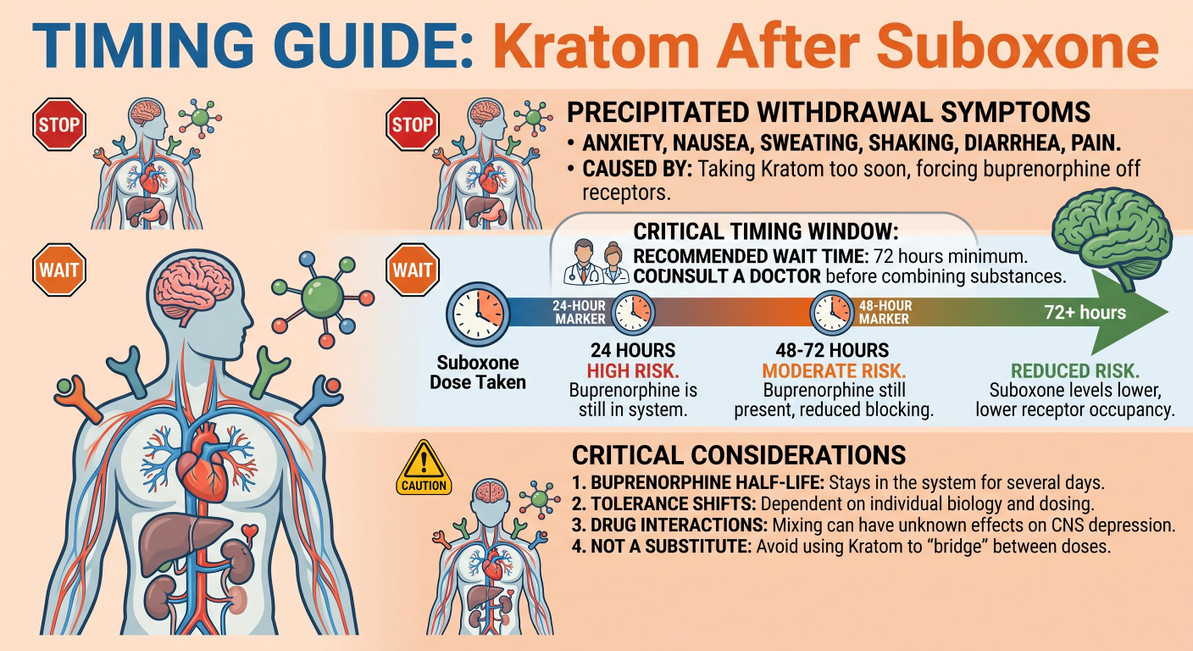
During the initial 0 to 24 hours following a dose of Suboxone, buprenorphine maintains dense saturation across available mu-opioid receptor sites throughout the central and peripheral nervous systems. Because buprenorphine's binding affinity vastly exceeds that of Mitragynine or 7-Hydroxymitragynine, the incoming plant alkaloids cannot dislodge the pharmaceutical molecules from their cellular anchors.
If an individual consumes Kratom during this early twenty-four-hour window, the active botanical alkaloids circulate through the bloodstream, encounter fully occupied receptor sites, and are eventually processed by the liver and kidneys without ever docking. This results in a muted experience where the Kratom produces virtually no noticeable botanical activity at the mu-opioid pathways. The consumer simply wastes the botanical product because the physical receptor sites remain locked behind the buprenorphine barrier. While minor secondary sensations from adrenergic or serotonergic pathways might still register faintly, the core botanical properties remain inaccessible.
The 24- to 72-Hour Elimination Curve
As time passes beyond the twenty-four-hour threshold, the biological balance begins to shift as the body metabolizes and clears the initial dose of buprenorphine. Between 24hrs.-48hrs. post-administration, buprenorphine molecules begin slowly detaching from receptor pockets, leaving an increasing number of binding sites open. Nevertheless, because buprenorphine's elimination half-life extends up to forty-two hours, a significant portion of receptors remain occupied or partially blocked throughout this intermediate phase.
Meaningful receptor availability generally opens between forty-eight and seventy-two hours, or even longer for steady-state daily Suboxone users. By the 72-hour mark, circulating buprenorphine concentrations drop low enough that incoming Mitragynine molecules can successfully bind to open mu-opioid sites without facing intense competition. For individuals who have taken Suboxone consistently over extended periods, the compound accumulates in fat reserves, meaning a window of three to four full days is often required before the nervous system becomes fully receptive to the natural alkaloid profile of Kratom.
Delivery Methods: How Kratom Formats Shape Uptake Rates
The physical medium used to ingest Kratom plays a direct role in how rapidly alkaloids enter circulation and reach the receptor sites. Modern processing has expanded far beyond traditional whole-leaf preparations, creating an array of retail products that vary wildly in absorption speed and digestive breakdown. Each Kratom product formulation moves through human metabolic pathways on its own timeline, influencing how efficiently the alkaloids present themselves to clearing receptors:
- Raw Powder: Traditional loose powder consists of dried, de-stemmed leaf tissue ground into fine particles that must pass through standard gastrointestinal digestion. The stomach and digestive tract slowly break down the raw plant cellulose, resulting in a steady absorption curve that requires thirty to forty-five minutes for initial uptake and up to two hours to reach peak plasma concentration.
- Gelatin and Vegetarian Capsules: Encapsulated Kratom encloses measured quantities of fine leaf powder inside hard two-piece shells made from bovine collagen or plant-derived cellulose. Because the outer casing must dissolve in warm gastric fluids before the powder can disperse, capsules add a fifteen- to thirty-minute delay, resulting in a gradual release of alkaloids into the digestive tract.
- Pressed Tablets: These solid units are manufactured by compressing micro-milled leaf powder or purified botanical extracts with binding excipients under high mechanical pressure. The dense structural integrity of a pressed tablet slows the rate of gastrointestinal breakdown, creating a prolonged disintegration phase that delivers a steady, extended release of alkaloids over several hours.
- Gummies: Edible gummies incorporate standardized Kratom extracts into a flavored gelatin or pectin base that begins breaking down partially through chewing before entering the stomach. Once swallowed, the gummy base is processed like food, directing the concentrated alkaloids through hepatic metabolism where liver enzymes process the compounds before systemic distribution.
- Liquid Drinks, Beverages, and Concentrated Shots: Liquid formulations utilize water-soluble Kratom extracts suspended in flavored beverage bases or concentrated small-volume bottles. Because the alkaloids are fully dissolved in liquid form, they bypass the breakdown stages required by solid plant fiber, moving rapidly through the stomach lining to produce measurable plasma levels within ten to fifteen minutes.
- Tinctures: They utilize liquid solvent extraction to capture dense concentrations of Kratom alkaloids in compact glass dropper bottles. When administered sublingually under the tongue, a portion of the active alkaloids diffuses directly through the permeable oral mucosa into capillary blood, partially bypassing the digestive tract for rapid systemic entry.
- Disposable Vapes: These compact, battery-powered electronic devices vaporize specialized liquid Kratom distillates for direct inhalation into the lungs. Inhaling the vapor allows active alkaloids to cross the thin alveolar membranes of the respiratory tract directly into arterial circulation, creating an immediate onset that peaks within seconds and clears the bloodstream far faster than ingested oral formats.
Physiological Variables: Vein Curing, Blends, and Metabolic Factors
Beyond simple hourly timelines and product formats, individual human biology and agricultural chemistry introduce crucial variables into the equation. Every Kratom harvest possesses a unique chemical fingerprint shaped by post-harvest handling, while every consumer possesses a distinct metabolic rate governed by genetics and prior exposure. These intersecting factors dictate the exact volume and ratio of alkaloids competing for clearance pathways.
Post-Harvest Curing, Vein Profiles, and Strain Formulations
In the commercial Kratom trade, names like "Maeng Da," "Bali," or "Borneo" refer to specialized curing recipes and powder blends rather than distinct botanical cultivars. The foundational leaf originates from the Mitragyna speciosa tree, but post-harvest processing changes the finished alkaloid ratios:
- Red Vein Formulations: Leaves undergo prolonged drying, outdoor sun curing, or enclosed bag fermentation, which oxidizes a portion of the baseline Mitragynine and elevates secondary oxidized compounds. These fermented blends lean heavily on pathways that require completely open mu-opioid receptors to be perceptible.
- Green Vein Formulations: Harvested foliage is dried indoors on large racks with controlled ventilation, preserving high chlorophyll content and locking in rich concentrations of unoxidized Mitragynine and speciogynine.
- White Vein Formulations: Leaves are subjected to rapid indoor drying or direct morning sunlight, often blending stripped leaf blade with a measured portion of stem-and-vein material to produce a crisp alkaloid ratio.
Because unfermented green and white formulations retain robust secondary adrenergic and serotonergic alkaloid profiles, an individual consuming them might register minor non-opioid activity slightly earlier in the clearance window, whereas deeply fermented red blends remain completely undetectable until the buprenorphine blockade has cleared.
Liver Enzyme Competition, Tissue Saturation, and User Tolerance
The human body relies heavily on the cytochrome P450 enzyme system in the liver—specifically the CYP3A4 and CYP2D6 pathways—to break down both buprenorphine and Kratom alkaloids. When Suboxone and Kratom are present in the body around the same time, they compete for these shared metabolic pathways. If the liver is fully occupied processing residual buprenorphine, the clearance of incoming Kratom alkaloids can be delayed, altering the expected rate of elimination.
Furthermore, individual tolerance and biological history create substantial variance in how the nervous system responds. A long-term Suboxone user whose receptors have been continuously saturated at a high daily milligram level will experience a much longer receptor desensitization phase. Conversely, someone who took a single, small dose of Suboxone will clear the compound much faster. Both buprenorphine and Kratom's primary alkaloids are lipophilic, meaning they store in adipose tissue reserves; individuals with higher body fat percentages or extensive usage histories will hold residual metabolites in their system longer, extending the necessary buffer period between the two substances.
Bridging the Gap Between Synthetic Blockades and Natural Leaf
Transitioning between a high-affinity pharmaceutical like Suboxone and the complex alkaloid matrix of Kratom requires respecting the unyielding biological timeline of receptor clearance. Because buprenorphine creates a resilient cellular blockade with a prolonged elimination half-life, consuming Kratom before the twenty-four to seventy-two-hour window has passed leads to completely muted receptor activity. Whether choosing traditional loose powder, rapid liquid extracts, or inhaled formats, the physical form cannot override the fundamental mechanics of molecular displacement and shared liver metabolism. Approaching this transitional crossroad with factual clarity permits individuals to look past guesswork and recognize the precise cellular rules that govern both synthetic and botanical compounds.
Disclaimer: This article is strictly for educational and informational purposes and does not constitute medical advice or clinical guidance. Kratom has not been evaluated by the U.S. Food and Drug Administration (FDA) and is not intended to diagnose, treat, cure, or prevent any condition. Always consult with a licensed healthcare provider before combining, starting, or adjusting any prescription medication, botanical supplement, or personal wellness regimen.
Recent Posts
-
A Kratom Usage Question: How Long After Taking Suboxone Can I Take Kratom?
Moving between modern prescription formulations and traditional botanical products often brings peop …Sep 14, 2026 -

What's Going on with Kratom in The Wolverine State? Is Kratom Legal in Michigan?
Specialty storefronts and neighborhood herbal markets across The Great Lakes region showcase a diver …Sep 13, 2026 -

Does Narcan Work on Kratom?
When emergency response tools enter mainstream public awareness, curiosity naturally spreads to how …Sep 10, 2026